
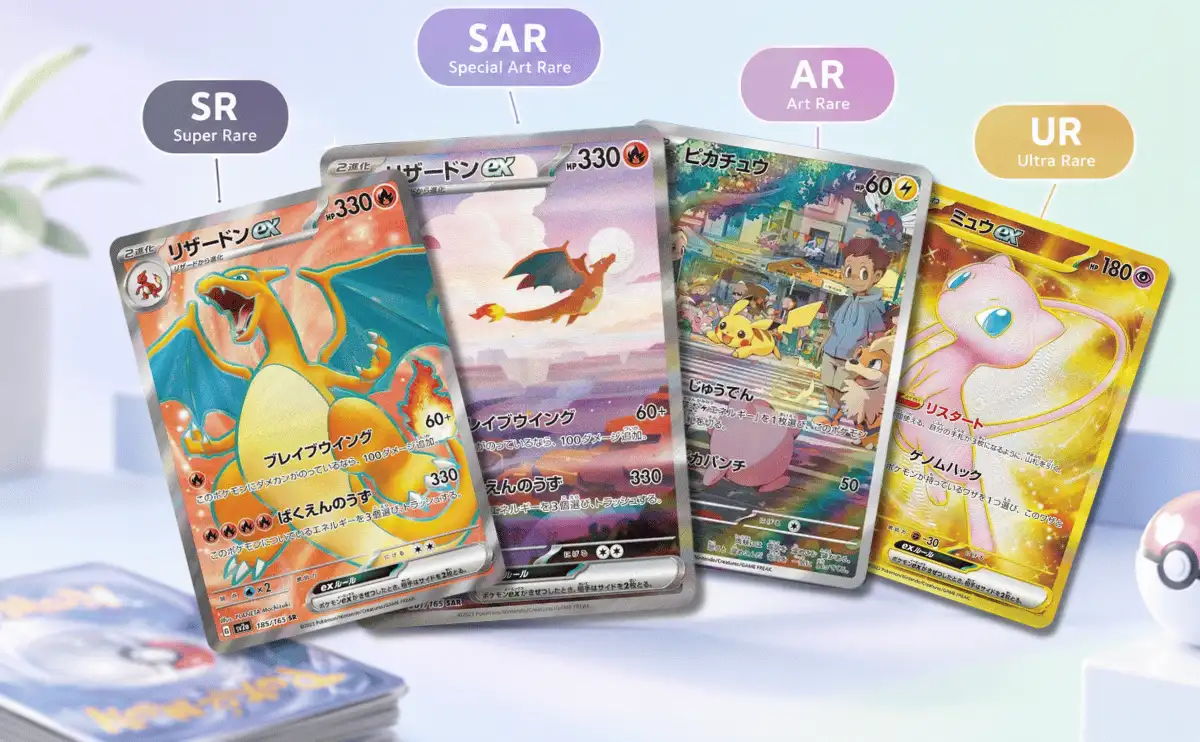
On Japanese Pokémon cards, rarity isn't shown with circles, diamonds or stars: it is shown with letters. C, U, R, RR, AR, SR, SAR, UR, and all the way up to the gold Ultra Rare… and these rarity codes have changed from one era to the next. The result: plenty of collectors outside Japan order single Japanese cards without knowing exactly what they are getting. This guide explains Japanese Pokémon card rarity from A to Z: where to read the rarity, what each symbol means, the full ranking from most common to rarest, the rarity codes of the older series, and how Japanese rarity differs from the English and French system.
Table of contents
- How can you tell the rarity of a Japanese Pokémon card?
- Japanese rarity ranking, from Common to Ultra Rare
- Rarity across the eras of Japanese Pokémon cards
- ACE, promo, shiny: the special rarities
- Japanese rarity vs. English and French rarity: the differences
- Rarity and the price of Japanese cards
- Quiz: Japanese Pokémon card rarity
- Frequently asked questions
How can you tell the rarity of a Japanese Pokémon card?
The rarity of a Japanese Pokémon card is printed in plain letters in the bottom-left corner, right next to the number and the set code. A code of one to three letters, for example C, RR or SAR, shows the rarity level. There is no symbol to decode: the rarity can be read straight off the card, whether it is a single bought on its own or a card from a freshly opened booster.
Three pieces of information sit side by side on this line, and they are read together:
- The set code, for example sv9a or s12a: it identifies the expansion.
- The number, in the form 085/063: the card's position in the set, and the number of "official" cards in the set.
- The rarity, in letters: C, U, R, RR, AR, SR, SAR, UR.
One detail that Japanese players know well and that Western buyers often discover too late: when the number is higher than the set total — 085/063, 223/193 — the card is a "secret rare". It is not counted in the set's official list, and it is a sign of high rarity, AR at the very least.
🔤 Did you know?
Rarity in letters has existed in Japan since the very first Pokémon cards in 1996, whereas English and French cards have always used symbols. Japanese cards are therefore easier for a beginner to sort: all you need is to be able to read the alphabet.
Japanese rarity ranking, from Common to Ultra Rare
Here is the complete rarity scale for Japanese Pokémon cards of the Scarlet & Violet era, the one used by current expansions. Read it from left to right, from the most common to the most sought-after.
| Code | Rarity | What it is | Appearance |
|---|---|---|---|
| C | Common | Common cards: Basic Pokémon, everyday Trainers | Non-holo |
| U | Uncommon | Uncommon cards, Stage 1 evolutions | Non-holo |
| R | Rare | Final evolutions, Trainers that are useful in play | Often holo |
| RR | Double Rare | Standard Pokémon ex cards | Holo, silver frame |
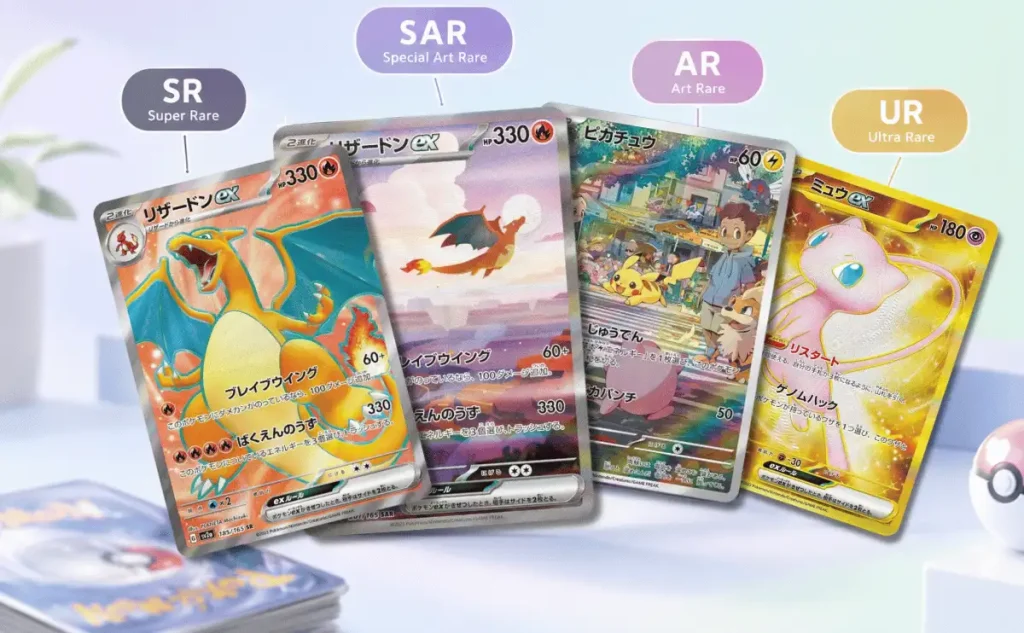
| AR | Art Rare | Full-card alternate art of a Common or Rare | Non-holo, full-page art |
| SR | Super Rare | Pokémon ex or Trainer in full art version | Textured holo |
| SAR | Special Art Rare | Pokémon ex or Trainer with a special, story-telling artwork | Textured holo, full-card art |
| UR | Ultra Rare | Gold version of an ex card, an item or an Energy | Gold, known as gold cards |
The line that matters: AR, SR or SAR?
This is the most common mix-up at the moment of choosing a card. An AR is the alternate art of an ordinary card, with no holo: pretty and affordable. An SR is the full art version of a Pokémon ex or Trainer card. An SAR adds a story-telling illustration on top of that, often by a renowned artist: it is the most sought-after rarity, the one that carries the value of a set. The SAR code on a card of Pikachu, Charizard or a popular Trainer almost always marks the flagship card of the expansion.
Between AR and SAR, the art covers the same area. What changes is the holo, the texture, and a price ratio that often runs from one to twenty.
Rarity across the eras of Japanese Pokémon cards
Rarity codes have not always been the ones we know today. Each major era of the Japanese TCG has added, removed or renamed rarities. To read the rarity of a card from 2018 or 2021, you need to know the list for its period.
Three eras, three rarity systems
Rarities C, U, R, RR (GX cards), SR (full art), HR (rainbow) and UR (gold). Few codes, easy to rank.
RR for V cards, RRR for VMAX and VSTAR, plus CHR and CSR (cards featuring a Trainer), S (shiny) and A (amazing). The era with the most rarities.
Back to a simple list: RR for ex, AR, SR, SAR and UR. The ACE code arrives for ACE SPEC cards, then MA with the new Mega cards.
| Rarity | Sun & Moon | Sword & Shield | Scarlet & Violet |
|---|---|---|---|
| "Boosted" Pokémon card | RR (GX) | RR (V), RRR (VMAX, VSTAR) | RR (ex) |
| Alternate art without holo | — | CHR | AR |
| Full art | SR | SR | SR |
| Special art | — | CSR, SA | SAR |
| Rainbow | HR | HR | — |
| Gold Ultra Rare | UR | UR | UR |
| Shiny | — | S | Through dedicated "shiny" sets |
The HR and CHR rarities disappeared with the Scarlet & Violet era, so cards that carry them are dated in advance. For a collection, that is an advantage: the rarity doubles as a way of dating the card, on top of the set symbol.
🌈 Did you know?
HR cards, or "Hyper Rare", were nicknamed "rainbow" because of their rainbow gradient. Highly sought after in the West, they were dropped in Japan with the Scarlet & Violet era: none of the new Japanese Pokémon cards carries this rarity any more.
ACE, promo, shiny: the special rarities
ACE SPEC cards
The ACE code designates ACE SPEC cards, items and tools so powerful that a deck can only contain one of them. Recognisable by their red frame, they have had their own rarity since their return in the Scarlet & Violet era.
Promo cards
A promo card does not come from booster packs: it is handed out in shops, at tournaments, in magazines or with a spin-off product. Its rarity reads "PROMO" and its number points to a promo series, not to a set. Some Japanese promos are among the most expensive cards in the Pokémon universe, including 1990s Nintendo cards printed in just a handful of copies.
Shiny cards
The shiny Pokémon, with their alternate colours, had their own S rarity in the Sword & Shield era. Today they are released in dedicated sets that reuse the classic rarities, with a number beyond the set total.
Mega cards
With the return of Mega Evolution, an MA rarity appears on some full-art Mega cards. It is the newest of the Japanese rarities, one to keep an eye on in new expansions and in the boosters that include them.
Japanese rarity vs. English and French rarity: the differences
English and French cards do not use letters but symbols — circle, diamond, star — supplemented by written labels: "Rare Holo", "Illustration Rare", "Special Illustration Rare", "Hyper Rare". The Japanese system is more compact and more precise, and the rarities do not always match term for term.
Japanese cards
- Rarity in letters, readable at a glance
- Secret-rare number beyond the set total
- Distinct AR and SAR rarities
- More full-art cards per set
English and French cards
- Geometric symbol + written label
- Secret rares are numbered in the same way
- "Illustration Rare" and "Special Illustration Rare"
- One Western edition combining several Japanese sets
A practical consequence: a Western set often combines two Japanese expansions, sometimes three. A Japanese AR can therefore end up as an "Illustration Rare" in a Western set that does not have the same name. To find the Japanese version of an English or French card, you first have to identify the original set.
Rarity and the price of Japanese cards
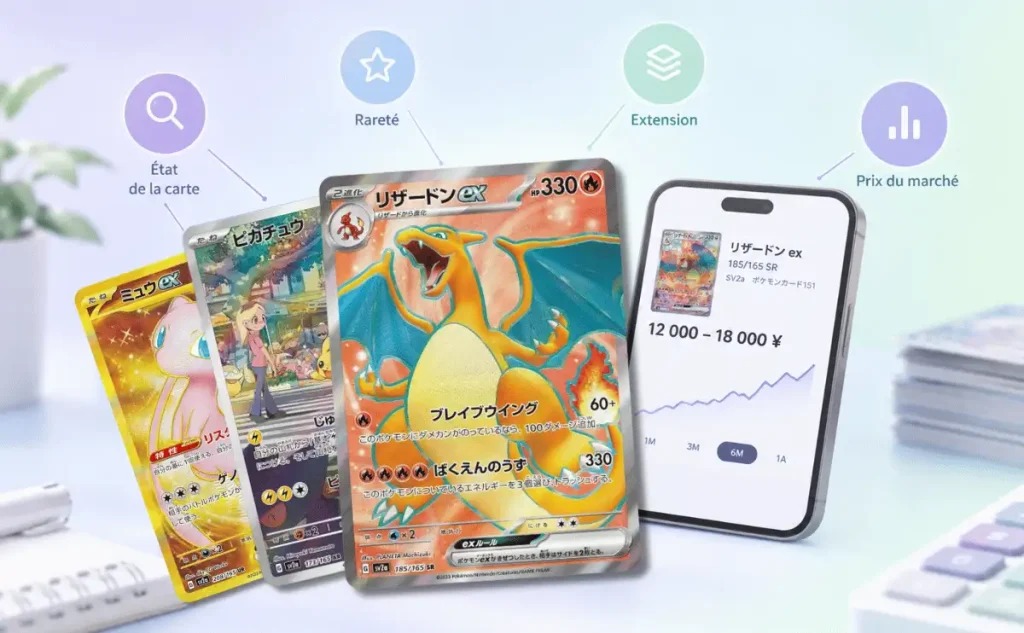
Rarity explains a large part of the price, but not all of it. An SAR of Pikachu or Charizard is worth several times an SAR of a less popular Pokémon from the same set, at strictly equal rarity. Condition matters just as much: a mint card with no defects and the same card with a dinged corner do not have the same market. To estimate a specific card, read our article on the value of a Japanese Pokémon card, which goes through the method criterion by criterion.
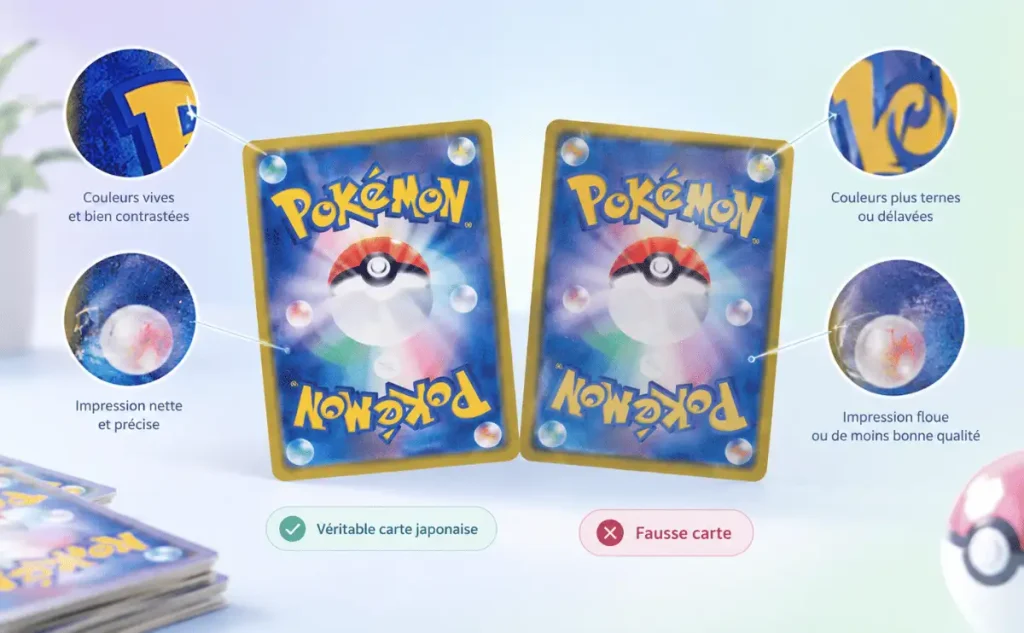
Rarity also attracts counterfeiters, who copy SARs and ultra rares first. Rare Japanese cards should therefore be bought with the care a private buyer takes when checking a branded product: the INPI (the French industrial property office) points out that possessing a counterfeit product is itself punishable, and French customs publishes a guide on how to avoid counterfeits whose reflexes apply to collectible cards.
On our Japanese Pokémon cards page, every card is sold as a single with its rarity, its set and a real photo, and the boosters come directly from Japan. Shipping is handled from France, by tracked letter, so that the cards arrive in the condition described. For a collection in the making, it is the safest choice: tracked delivery protects ultra rares and commons alike.
🎴 Did you know?
Full-art Japanese cards are so numerous that some expansions have more secret cards than "official" ones. A set of 63 cards can thus contain more than 100: the numbering 085/063 is not a printing error.
Want to add an SAR or an AR to your collection?
See the Japanese Pokémon cards in stockQuiz: Japanese Pokémon card rarity
Three questions on the rarity of Japanese cards
1. A card carries the number 085/063. What does it mean?
No: this number is intentional. Cards beyond the set total are the secret rares.
Correct. The number is higher than the official total: it is a secret rare, of AR rarity at the very least.
No: a promo carries the PROMO mention and a promo series number, not a set number.
2. What is the rarity difference between AR and SAR?
No: both have full-card art.
Correct. The AR is an ordinary card with no holo; the SAR is an ex or a Trainer, holo and textured.
No: they are two distinct rarities, with a significant price gap.
3. Which rarity disappeared with the Scarlet & Violet era?
No: gold ultra rares still exist.
Well spotted. Rainbow HR cards have no longer been printed in Japan since that era.
No: the SR rarity is present in all three eras.
Frequently asked questions
How can you tell the rarity of a Japanese Pokémon card?
The rarity is printed in letters in the bottom-left corner, next to the number and the set code: C, U, R, RR, AR, SR, SAR or UR for current cards. A number higher than the set total also signals a secret rare.
What do the rarity symbols on a Japanese Pokémon card mean?
Japanese cards do not use symbols but letters: C for Common, U for Uncommon, R for Rare, RR for ex cards, AR for an alternate art, SR for a full art, SAR for a special art and UR for a gold Ultra Rare.
What is the Japanese rarity ranking, from most common to rarest?
C, U, R, RR, AR, SR, SAR, UR. ACE SPEC cards and promos have their own rarity. In earlier eras, RRR, HR, CHR, CSR and S slotted into this list.
What is the difference between Japanese and English or French rarities?
Japan uses letters, while English and French cards use geometric symbols accompanied by written labels such as "Illustration Rare". Japanese rarity distinguishes alternate arts more finely, and one Western edition often combines several Japanese expansions.
Which rarity is the hardest to pull from a Japanese booster?
SARs and UR ultra rares are the rarest to pull when opening boosters. The Pokémon Company publishes no official pull rate; the estimates in circulation are based on display openings, not on data from the publisher.
Key takeaways
The rarity of a Japanese Pokémon card is read in letters, in the bottom-left corner, and ranks from C to UR through the three art rarities AR, SR and SAR. The codes have changed across the eras, and a number higher than the set total marks a secret rare. Compared with the English and French symbol system, Japanese rarity is more precise, but you need to know the era of the cards. Rarity, the popularity of the Pokémon and condition then determine the value; rarity alone never tells the whole story, but it is always where you should start.

 Français