
You have just received your first Japanese Pokémon cards, you turn one card over… and the back doesn't look like the one you know. Don't panic: the back of a Japanese Pokémon card is different from the English or French back, and that is perfectly normal. This guide explains why, traces the successive versions of the Japanese card back since 1996, and above all shows how to use the back to tell whether a card, a booster or a box is authentic. Because on the market for Japanese boosters and cards, the Japanese Pokémon card back is the first clue a collector examines.
Table of contents
Why is the back of a Japanese Pokémon card different?
Japanese Pokémon cards and English or French cards do not come from the same printer. In Japan, the game is published by Creatures and The Pokémon Company, with its own logo, its own language and its own back design. Western cards, for their part, are produced by Pokémon Company International for Europe and America, with a back shared by all the English, French, German and Italian editions.
The result: a Japanese card and a French card show the same Pokémon, but their backs don't have the same colour, the same logo or the same layout. It is neither a flaw nor a sign of a counterfeit. It is simply the official back of the Japanese TCG, the one that all Japanese boosters have shared for more than twenty years.
A back that differs from the English or French back is not a sign of a fake card: it is the normal back of every Japanese Pokémon card.
This difference has a practical consequence: a Japanese card can be spotted at a glance in a deck, which is why official Western tournaments do not accept it. For a collector, on the other hand, the Japanese back has become a sought-after marker.
🃏 Did you know?
The back of Western Pokémon cards has barely changed since 1999. The back of Japanese cards, however, was completely redesigned in 2001: Japanese cards have therefore had two backs, where English and French cards have had only one.
The versions of the Japanese Pokémon card back
Two backs have followed one another on Japanese cards, and the dividing line between them is one of the most useful landmarks for dating a card.
The two backs of Japanese Pokémon cards
Old back: Poké Ball on a dark background, Japanese "Pocket Monsters Card Game" logo. The one on Base Set cards and the first expansions.
New back: Poké Ball on a blue background with the "Pokémon" logo in Latin letters. Introduced with the e-Card series, it permanently replaces the old one.
The 2001 back has remained unchanged on all Japanese expansions, boosters and box sets. Korean cards use it too.
The old Japanese back (1996-2001)
The first Japanese Pokémon cards had a dark back, decorated with a large Poké Ball and the Japanese logo of the game. This back goes with the most sought-after vintage cards: Base Set, Jungle, Fossil, Team Rocket, Neo. It is also the one counterfeiters copy most, because these rarities fetch high prices. A card with the old back always deserves a careful examination of its condition and its print quality.
The new Japanese back (since 2001)
With the e-Card series, Japan adopted a blue back carrying the "Pokémon" logo in Latin characters. It is the back of all current Japanese cards, from the Scarlet & Violet expansions to the anniversary boxes. It resembles the Western back without being identical to it: the blue is lighter, the Poké Ball is bigger, and the "Trading Card Game" wording is absent.
Japanese, Korean, Western: three backs not to be confused
| Edition | Back | Logo | Allowed in Western tournaments? |
|---|---|---|---|
| Japanese (since 2001) | Light blue, large Poké Ball | Latin "Pokémon" | No |
| Japanese (before 2001) | Dark, central Poké Ball | Japanese logo | No |
| Korean | Identical to the current Japanese back | Latin "Pokémon" | No |
| Western (EN, FR, DE…) | Dark blue, swirl | "Pokémon" + "Trading Card Game" | Yes |
An important point for buyers of international boosters: Korean and Chinese cards share the Japanese back. A Japanese back therefore does not guarantee a Japanese card; it is the text on the front, in kana and kanji, that confirms it.
Real or fake: checking a Japanese card by its back
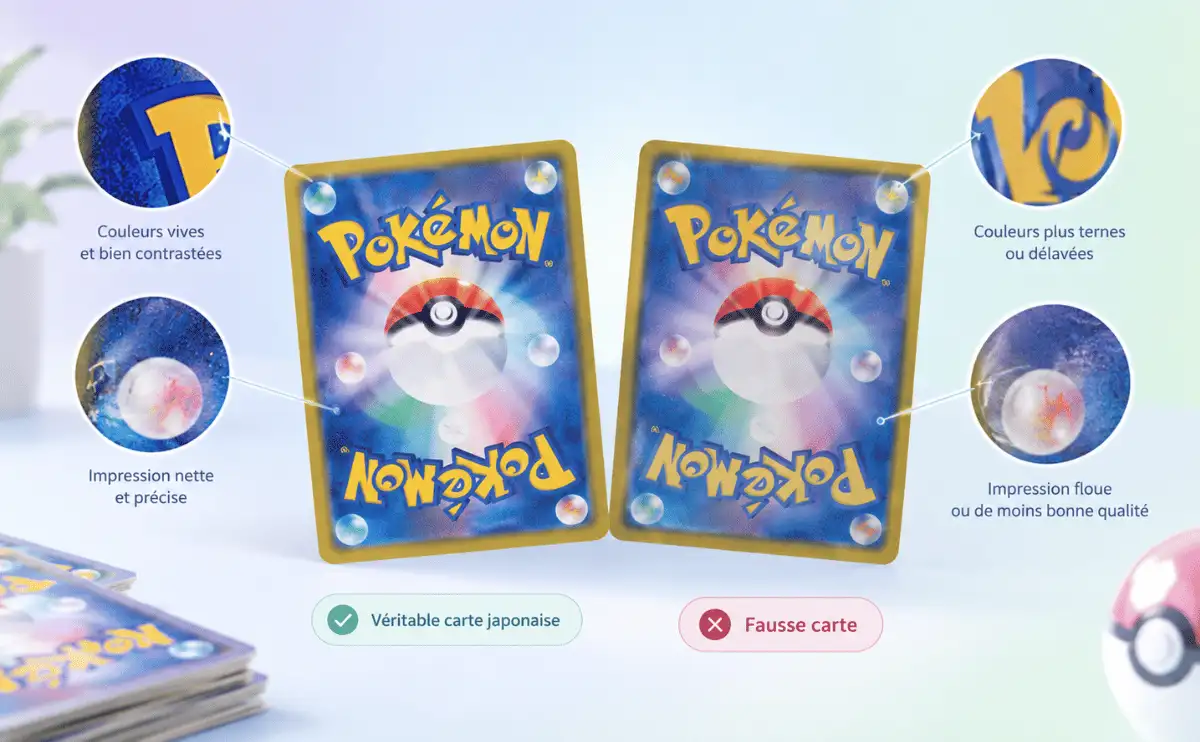
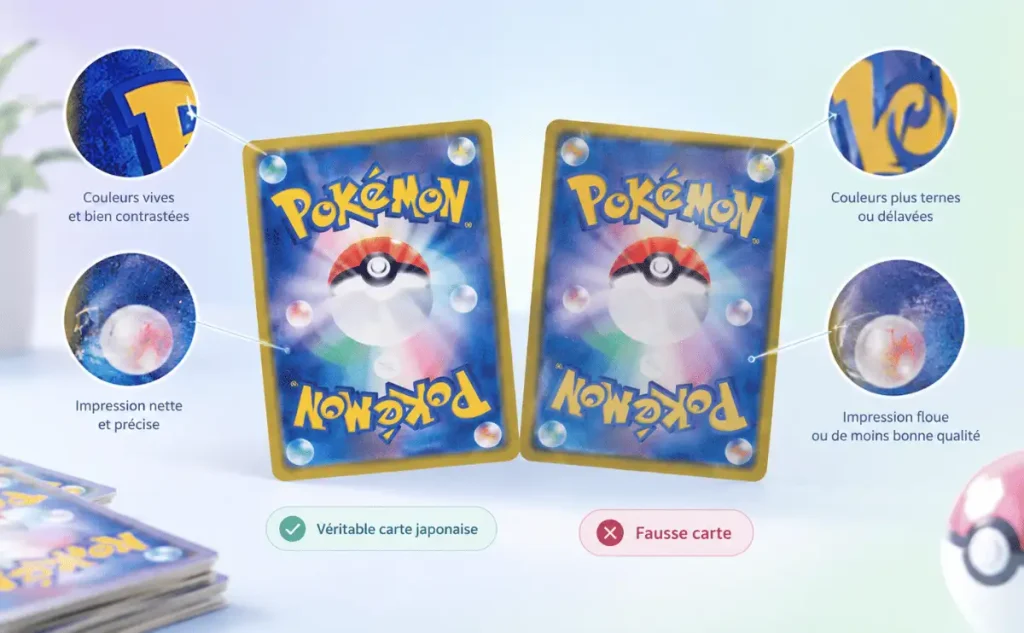
The Japanese Pokémon card back is where counterfeits give themselves away most often. The front only requires a convincing illustration; the back requires an exact industrial print, and that is where copies fail. Here are the six points to check, in order.
1. The shade of blue
The blue of the Japanese back is stable from one expansion to the next. A fake card leans towards purple, turquoise or a washed-out blue. Always compare it with a Japanese card you are sure about, taken from a booster you opened yourself.
2. The sharpness of the print
Look at the outline of the Poké Ball and the letters of the logo with a magnifying glass. On a genuine card, the edges are sharp and the solid areas are uniform. On a counterfeit, you see a coarse dot pattern, smudges or blurring along the edges.
3. The card edge
An authentic Japanese card is a sandwich of several layers of cardboard with a thin dark layer in the middle. The edge therefore shows a dark line. A fake card is often a uniform white, or on the contrary blackened with a marker.
4. The light test
Hold the card in front of a lamp. A genuine card lets through a soft, even glow. A counterfeit, too thin or too thick, lets through too much light or blocks almost all of it.
5. Feel and weight
Japanese cardstock has a matte grain and a distinctive stiffness to the touch. A fake card feels slippery, too flexible or unusually shiny. If you have a precision scale, a standard Japanese card weighs around 1.7 g; a marked difference should raise an alarm.
6. The logo details
Proportions of the Poké Ball, letter spacing, position of the logo: counterfeiters work from photos and get the dimensions wrong. A slightly off-centre logo or an oval Poké Ball is enough to condemn a card.
Genuine Japanese card
- Consistent blue, identical to boosters
- Sharp print, clean solid areas
- Dark line visible on the edge
- Soft glow in the light
- Matte grain, firm stiffness
Fake card
- Purple, turquoise or washed-out blue
- Visible dot pattern, blurry outlines
- White edge or edge blackened with a marker
- Too much or too little light
- Slippery surface, card too flexible
🔦 Did you know?
The "rip test", which consists of tearing a card apart to see its dark central layer, is the only foolproof test… and the only one that destroys the card. Collectors only carry it out on worthless common cards, never on a card bought for its rarity.
How to spot a fake Japanese Pokémon card
The back is not always enough. Well-made counterfeits of Japanese cards do exist, and the examination then has to extend to the front and to the circumstances of the purchase.
Signs on the front
The kana and kanji of a fake card are often poorly rendered: strokes that are too thick, distorted characters, mistakes in the Pokémon's name. The quality of the illustration is lower, the colours are over-saturated, and the holo pattern of shiny cards does not match the official pattern of the series.
Signs in the purchase
A price far below the market, a seller with no reviews, generic photos rather than photos of the actual card, lots of rare cards sold "in bulk": each of these should make you postpone the purchase. Sealed products are not spared either: counterfeit Japanese boosters and boxes are in circulation, with plastic wrap that is too loose or an unreadable barcode.
French customs points out that these reflexes apply to all products: abnormally low prices, poor packaging, printing mistakes. Its guide on how to avoid counterfeits also states that possessing counterfeit products exposes you to penalties, even if you bought them in good faith.
And what if you have already bought a fake Japanese card? Ask the seller or the platform for a refund, flagging your doubts about its authenticity, keep the photos and the shipping packaging, and do not put the card back on sale. The INPI (the French industrial property office) details the remedies available against counterfeiters.
Buying Japanese cards without risk
The best guarantee remains provenance. A sealed booster or set bought from an identified reseller, single cards photographed front and back, a seller whose orders are shipped from Japan or from France with tracking: these are the things that make a purchase safe, far more than an after-the-fact examination.
Our Japanese Pokémon cards page shows each card with its real photo, its set and its number, so that the back as well as the front can be checked before you order. Cards and boosters are brought back directly from Japan, then shipped from France.
One last tip for collecting with peace of mind: always keep a common card from a booster you opened yourself. It will serve as a reference for comparing the back of any new Japanese card that enters your collection guide.
Want to complete your collection with authentic Japanese cards?
See the Japanese Pokémon cards in stockQuiz: the back of Japanese cards
Three questions on the back of Japanese Pokémon cards
1. The back of a Japanese card is different from the English or French back. What does that mean?
No: all Japanese cards have a back that differs from the Western back. It is their official back.
Correct. Japan prints its own cards, with its own back, since 1996.
No: there is no error, the Japanese back is simply a different design.
2. In what year did the back of Japanese cards change?
No: 1999 was when the cards arrived in the West, not when the Japanese back changed.
Correct. The 2001 e-Card series introduced the blue back with the Latin logo, still in use today.
No, much earlier: the new back dates from 2001.
3. Which test is the most reliable for spotting a fake card without damaging it?
No: water damages the card and proves nothing, as some counterfeits are laminated.
Well spotted. The dark line on the edge and the soft glow in the light are the two surest clues.
A low price is a warning sign, not proof: you need to examine the card itself.
Frequently asked questions
Why is the back of a Japanese Pokémon card different from the English or French back?
Because Japanese cards are printed in Japan by The Pokémon Company, with their own design, while English and French cards share the common back of the Western editions. Both backs are official; a Japanese back is in no way a sign of a counterfeit.
How can you tell if a Japanese Pokémon card is fake?
Compare the blue of the back with a card you know is genuine, look for a printing dot pattern or blurry outlines, check the edge (a dark line should be visible), hold the card in front of a lamp, and check the kana on the front. A very low price and a seller with no reviews complete the body of evidence.
How can you tell from the back whether a Japanese Pokémon card is real or fake?
Three checks are enough in most cases: the shade of blue, the sharpness of the logo and the Poké Ball, and the dark line on the edge. If any one of the three is off, the card is very probably fake.
What are the different versions of the Japanese Pokémon card back?
Two: the old dark back with the Japanese logo, used from 1996 to 2001, and the blue back with the "Pokémon" logo in Latin letters, introduced with the e-Card series in 2001 and still in use. Korean cards use the current Japanese back.
Can you play a Japanese card in a Western tournament?
No. Official Western tournaments only accept cards with a Western back, precisely because a Japanese card can be spotted in a deck. Japanese cards are meant for collecting or for tournaments held in Japan.
Key takeaways
The Japanese Pokémon card back is puzzling at first sight, then becomes the collector's best ally. It differs from the English and French back because Japan prints its own cards, and it has come in two versions, the one from before 2001 and today's, which is shared with Korean cards. Shade of blue, print sharpness, dark line on the edge, glow in the light, grain of the cardstock: five thirty-second checks that unmask most counterfeits. And when doubt remains, provenance settles it: a sealed booster, a card photographed on both sides, an identified seller.

 Français