
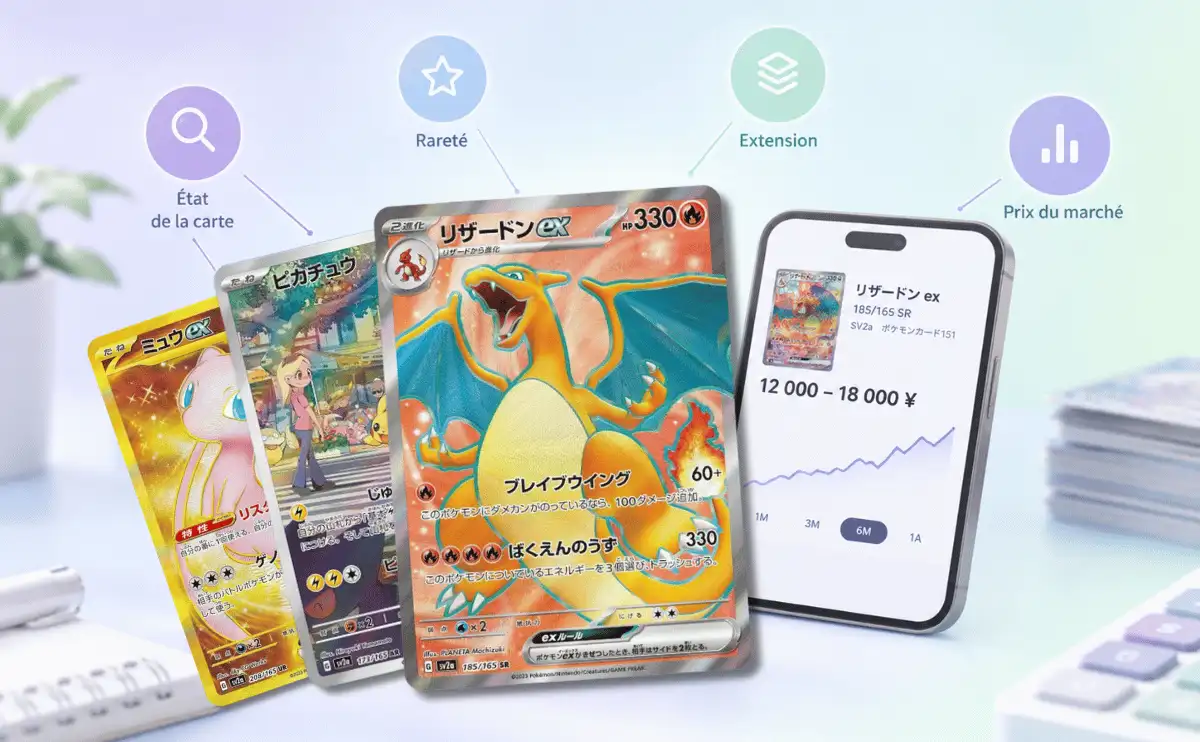
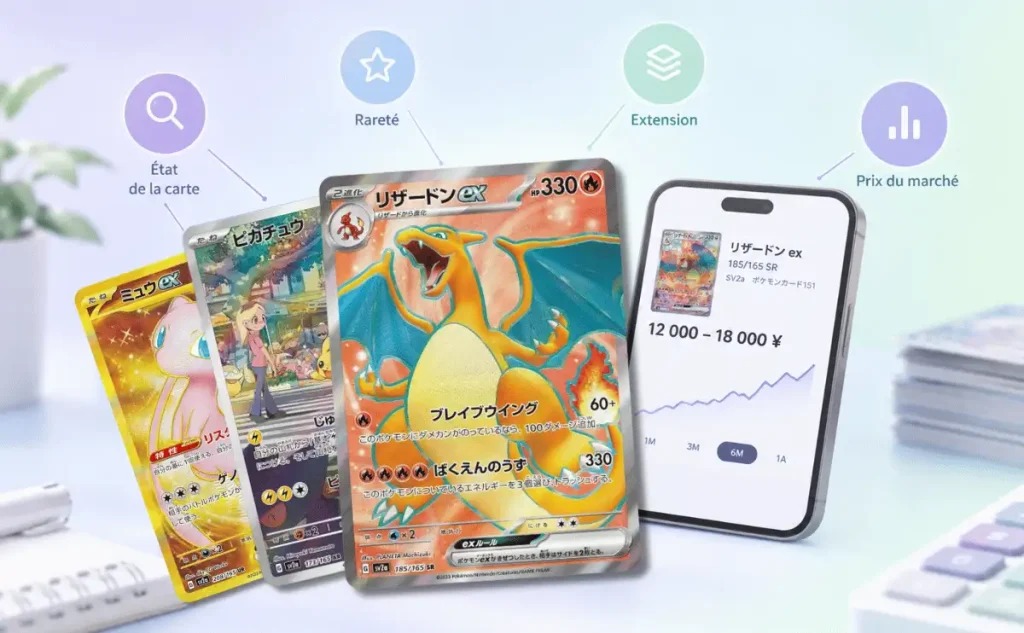
Japanese Pokémon cards attract more collectors every year, drawn in by their illustrations and by booster boxes (displays) and boosters that are cheaper than the English or French versions. But once you have the Pokémon cards in your hands, the question comes back: what is this card worth? This guide covers the value of a Japanese Pokémon card from every angle: the criteria that set the value of a Japanese card, the options for checking a price, the value gap between Japanese and French cards, and the mistakes that skew the valuation of a Pokémon card collection.
Table of contents
- How do you estimate the value of a Japanese Pokémon card?
- The 4 criteria that set the value of Japanese cards
- Displays and boosters: the value of sealed Pokémon cards
- Where to check the value of a Japanese Pokémon card
- Japanese or French cards: the value gap
- Collectors' valuation mistakes
- Where to sell your Japanese Pokémon cards
- Quiz: test your collector's instincts
- Frequently asked questions
How do you estimate the value of a Japanese Pokémon card?
Estimating the value of a Japanese Pokémon card means finding the real price at which identical cards have sold, then adjusting for condition. The amount shown in a listing is worth nothing: only a completed sale is a reference on the market. The method comes down to five steps, valid for a single card as for an entire collection of Japanese cards.
- Identify the set using the symbol printed at the bottom of the card.
- Note the number of the card and its rarity code.
- Assess the condition under raking light: corners, edges, centring, surface.
- Look up completed sales of the same card, in the same Japanese version.
- Take the median of the latest sales, never the highest amount.
This discipline frames the value of most of the Japanese Pokémon cards in an everyday collection. Sealed displays and boosters, like vintage Pokémon cards, follow a separate market logic, covered below.
🃏 Did you know?
The first Japanese Pokémon cards of 1996 carried no set symbol: collectors recognise them by the typography and the back of the card. This is one of the reasons counterfeiters so often target these Japanese cards.
The 4 criteria that set the value of Japanese cards
1. Rarity and its Japanese symbols
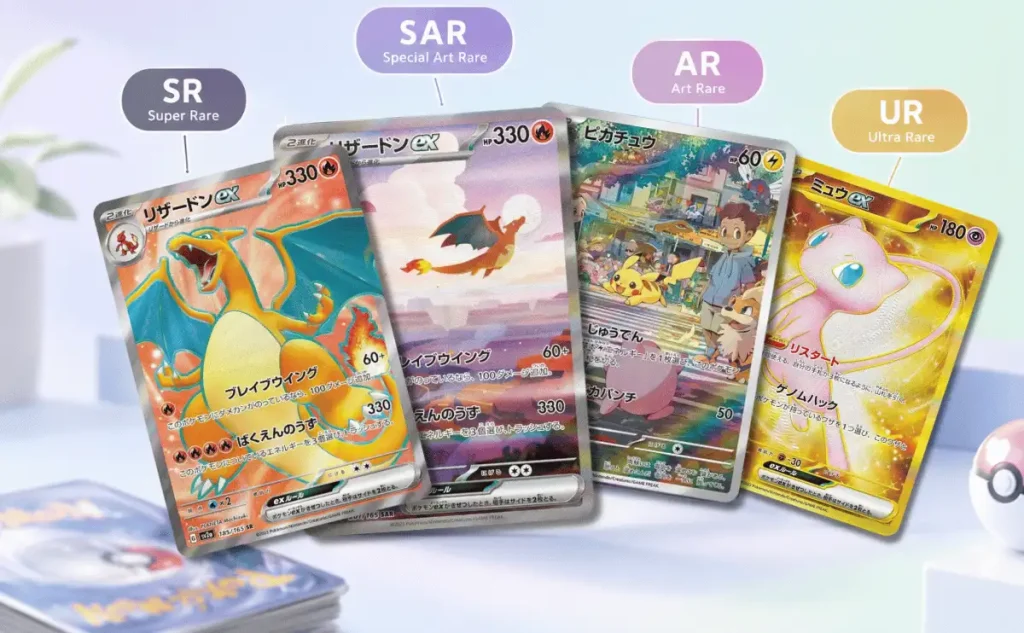
The rarity system of Japanese cards does not reuse the symbols of the French version. A code of two or three letters, printed near the card number, shows its level. Pokémon cards with full-page illustrations, known as full arts, concentrate collector demand and the highest values.
SAR and UR cards are the pinnacle of the newer series and the most sought-after Pokémon cards in each set. VSTAR, VMAX and EX cards are traded as much for their playability as for their illustrations. A Charizard card in SAR is routinely worth ten times a Charizard RR from the same set — a value gap that collectors know well.
2. The condition of the card
Condition weighs as much as rarity in the value of a Japanese Pokémon card. A card with perfect centring and a card with a whitened corner can be separated by a ratio of one to four. Four points to check: centring of the illustration, wear on the corners, sharpness of the edges, micro-scratches on the surface. This quality is what collectors pay for, not the name of the Pokémon.
3. The set and the number
Two Pokémon cards with the same artwork but from different versions are worlds apart in value. A Charizard card from an anniversary set and the same card from a standard expansion are sometimes separated by a ratio of one to fifty. The set takes priority over the Pokémon shown: it is the collector's first reflex before buying a Japanese card.
4. Grading
Grading means having the quality of a card rated by an independent company, which seals it in a slab. PSA is the reference most followed by European collectors. A Japanese card graded 10 has a clearly higher value than the same raw Pokémon card, but grading comes with a cost and a wait: it is only justified on the cards in the collection that are already sought after.
| Criterion | Impact on value | Can you check it yourself? |
|---|---|---|
| Rarity (printed code) | Very strong | Yes, immediately |
| Condition / centring | Very strong | Yes, in the light |
| Set and number | Strong | Yes, via the symbol |
| Grading | Strong, but paid | No, third-party company |
| Pokémon shown | Moderate | Yes |
Displays and boosters: the value of sealed Pokémon cards
Single cards are not the only ones with a value. Sealed Japanese displays (booster boxes) and boosters make up a market of their own, closely followed by Pokémon card collectors. A Japanese display generally contains 30 boosters of 5 cards, against 36 boosters of 10 cards for a French display: the Japanese display therefore costs less, but the card-by-card comparison remains to be made.
The value of a booster or a display depends on three things: the series, its availability in shops in Japan, and the value of the SAR and SR cards it may contain. As soon as a series stops being produced, the displays available on the second-hand market go up. It is one of the collectors' favourite options for those who want to collect Japanese cards on a controlled budget: a new display of a recent series costs less than the Pokémon cards it contains bought separately.
Value of a sealed booster — comparative index (base 100 = French version)
Indicative orders of magnitude, excluding shipping and import costs. The gap varies by card series and by the age of the set.
Where to check the value of a Japanese Pokémon card
There is no official price guide for Japanese Pokémon cards. No institution publishes a price scale: the market alone sets the value of each card, which means collectors have to cross-check several options.
| Tool | Reliability for Japanese cards | What to look at |
|---|---|---|
| Cardmarket | Good, but a thinner catalogue of Japanese cards | The 30-day average, not the lowest price |
| eBay — completed sales | Very good | Filter on "Sold items", not on current listings |
| Japanese marketplaces | Excellent for new cards | The price in yen, excluding import costs |
| Photo-scanning apps | Low to average | A starting point, never a conclusion |
Can you estimate a Japanese card from a photo?
Some apps recognise a Pokémon card from a photo and return a value range. They regularly confuse Japanese cards with one another, and above all they do not judge condition. Use them to identify the set, then check the value by hand against completed sales.
💴 Did you know?
In Japan, Pokémon card shops display the value of each single card on small price tags that are changed almost daily. The same Japanese card can see its value move twice in a week depending on tournament results.
Japanese or French cards: the value gap
At equivalent rarity, a Japanese card is generally worth less than a French one. Three reasons explain it: Japanese print runs are larger, displays and boosters are sold more cheaply there to begin with, and the demand of European collectors remains concentrated on localised cards.
This difference pushes many collectors towards Japanese boosters, displays and single cards: on an equal budget, you open more Pokémon cards and gain access to exclusive illustrations that are absent from French cards. To buy card by card, our Japanese Pokémon cards page lets you compare the selection of Japanese cards available, with the value of each single card.
Only a completed sale is a reference: the amount shown in a listing says nothing about the real value of a card.
A Korean card, often mentioned as a comparison, follows the same print-run logic but with much weaker demand in Europe: its resale value there is generally lower than that of Japanese cards.
A practical point for collectors who resell regularly: income from a buy-and-resell card business is not subject to the same tax regime as the occasional sale of personal items. The French Ministry of the Economy details the cases on its page on income from online platforms.
Collectors' valuation mistakes
- Relying on the asking price rather than the price obtained: the gap often exceeds 40%.
- Confusing a reverse card with a holo card, two very different values.
- Believing a 1996 Pokémon card is valuable by default: age without rarity creates no value.
- Ignoring centring, which nonetheless conditions every grading score.
- Paying top price for a sealed display when the series is still in production in Japan.
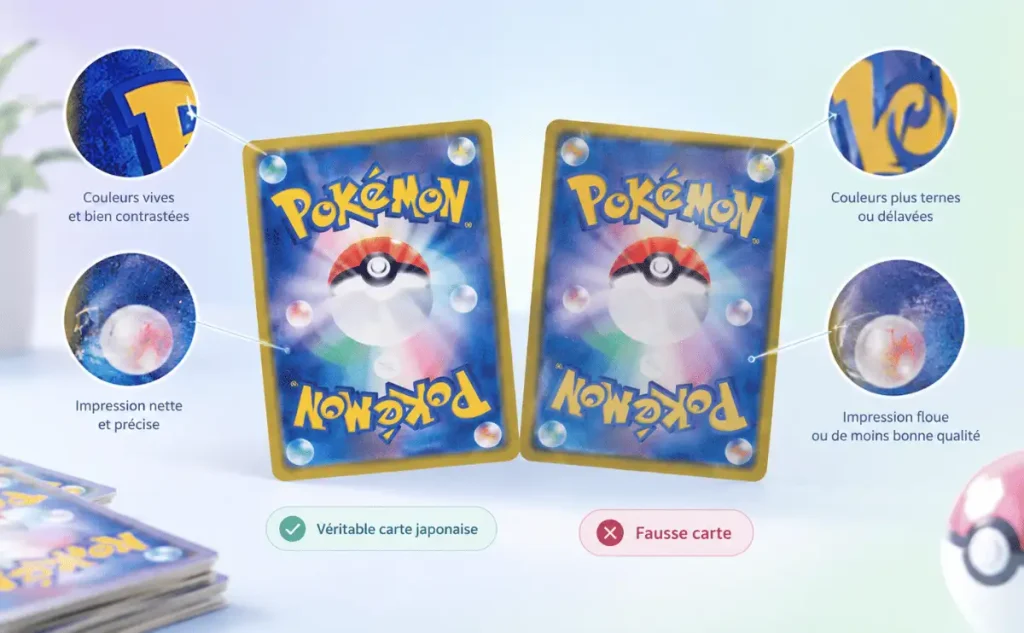
- Neglecting authenticity: the back of the card, the layered edge and the print quality can be checked in thirty seconds.
On that last point, French customs publishes reflexes that carry over to Pokémon cards: abnormally low price, poor packaging, printing mistakes. Its guide on how to avoid counterfeits also points out that possessing counterfeit cards is punishable by penalties.
🔍 Did you know?
The light test works better than the water test: a genuine Pokémon card lets through a soft, even glow, whereas a counterfeit card often reveals a dark zone in the centre, the trace of the missing intermediate cardboard layer.
Where to sell your Japanese Pokémon cards
Three options, depending on what you prioritise. Specialist platforms bring together knowledgeable collectors but take a commission. General marketplaces reach a wider audience, with a higher risk of non-payment. Selling a collection to a card shop pays less, but immediately and with no hassle.
The choice depends on the unit value of the cards: below a few euros, sell the Pokémon cards in lots; above that, take care over the photo of each Japanese card and its description, mentioning set, number, rarity and condition. For sealed displays and boosters, always specify the series and whether the plastic wrap is intact.
Are you looking to complete your collection of Japanese cards rather than resell it?
See the Japanese Pokémon cards in stockQuiz: test your collector's instincts
Three questions on the value of Japanese Pokémon cards
1. Which code designates the highest rarity of a Japanese card?
Not quite. RR stands for "Double Rare", one notch below the illustrated cards.
Correct. SAR, for Special Art Rare, is among the Pokémon cards most sought after by collectors.
Close. AR designates an alternate illustration, less rare than an SAR card.
2. Which amount should you base your estimate of a Pokémon card's value on?
No: a listing can stay online for months without finding a buyer.
No: a record price often corresponds to a graded card or to an impatient collector.
Exactly. The median of the latest real sales is the only solid benchmark of value on the Japanese card market.
3. How many boosters does a Japanese display contain?
No: 36 boosters is the format of French card displays.
Well spotted. 30 boosters of 5 cards: that is why the value of a Japanese display cannot be compared directly with that of a French display.
No, it's 30. Watch out for lots of 24 sold to collectors as complete displays.
Frequently asked questions
How do you estimate the value of a Japanese Pokémon card?
Identify the set from the printed symbol, note the number and the rarity code, assess the condition under raking light, then look up completed sales of the same card in its Japanese version. Use the median of the latest transactions, never the amount shown in a listing.
How can you tell if a Japanese Pokémon card is rare?
The code printed near the number tells you directly: C and U are the common cards, R and RR are mid-range, and AR, SR, SAR and UR make up the top of the scale. A full-page illustration almost always signals a rare, and therefore valuable, Japanese card.
Where can you sell Japanese Pokémon cards?
On a specialist platform to reach knowledgeable collectors, on a general marketplace for a wider audience, or to a card shop for an immediate sale. Below a few euros per card, selling cards in lots remains the most profitable.
What is the most expensive Japanese Pokémon card?
The records belong to tournament promo cards from 1997 to 2000, printed in just a handful of copies and graded at the highest level. These cards trade at auction, and their value has nothing to do with the market for everyday Japanese cards.
Is a Japanese display a good investment?
A sealed display of a discontinued series generally gains value, but a display of a series still in production in Japan has no reason to go up. Always check the status of the series before buying sealed cards above their release price.
Key takeaways
Estimating the value of a Japanese Pokémon card is a matter of neither instinct nor luck: rarity, set, condition and, for the strongest cards, grading are enough to frame a realistic value. Displays and boosters follow a similar market logic, where the status of the series counts as much as the Pokémon cards they contain. The rule that protects collectors from every disappointment fits in one line: only a completed sale is a reference. Applied to each Japanese card, it turns a rough collection into a priced inventory, and guides buying as well as reselling.

 Français